In today’s competitive landscape, companies must transform real-time shop floor data into strategic insight to stay ahead. That’s where the MES vs MOM question comes in, as both concepts represent different stages in the digitalization journey of manufacturing. The key question is whether a business should focus on improving speed on the production line or on optimizing the entire factory operation. This decision defines the difference between MES and MOM.
Overview of MES and MOM
A Manufacturing Execution System (MES) is designed to monitor, control, and optimize production processes in real time—from raw material input to finished goods output. It processes data collected from machines, operators, and sensors, providing instant visibility into production status. MES ensures that production plans are accurately executed on the shop floor and that operators follow standardized workflows.
Manufacturing Operations Management (MOM), on the other hand, goes beyond execution and covers all operational processes across the factory. It integrates production with quality management, maintenance operations, inventory tracking, and R&D processes. For many professionals entering the field, the question “What is MOM?” naturally arises. The answer lies in its ability to unify all supporting processes of manufacturing under a single digital framework.
MOM is often defined within the scope of ISA-95 standards as a methodology covering all Level 3 operations. It not only evaluates how production is performed but also analyzes how supporting processes influence production outcomes. By synchronizing departments, MOM aims to improve overall equipment effectiveness (OEE) and drive enterprise-wide efficiency.
While MES systems typically operate with a vertical focus on production, MOM provides horizontal integration across departments. MES tracks machine performance and downtime in real time, whereas MOM connects these events with maintenance schedules and spare parts availability. Businesses must manage this transition based on their level of digital maturity.
Key Differences Between MES and MOM
Understanding MES vs MOM requires analyzing their focus areas and scope. The difference between MES and MOM is not only technical but also conceptual. MES concentrates on how production is executed at a granular level, while MOM provides a broader view of how operations are managed across the organization.
From a process management perspective, MES is essential for real-time response and operational discipline. MOM enhances this discipline by integrating additional layers such as quality control, inventory tracking, and predictive maintenance. The commonly discussed MES vs MOM comparison ultimately reflects a balance between specialization and expansion—one system speaks the language of machines, while the other speaks the language of the entire factory.
Operational vs strategic systems
MES delivers the tactical and operational data required to meet shift-based production targets. It identifies why a machine stops or when an operator deviates from standard time, enabling supervisors to take immediate corrective actions. In this sense, MES functions as the real-time control system of the production floor.
MOM, however, operates at a more strategic level. It uses collected data not only to resolve immediate issues but also to improve overall workflows. From maintenance team performance to supply chain impact on production speed, MOM provides a comprehensive perspective. This enables senior management to make informed long-term investment and capacity planning decisions.
At the strategic level, the integration and interpretation of data become critical. Here, the difference between MES and MOM becomes clear: MES generates data, while MOM combines it with inputs from other departments to create meaningful insights. Optimizing profitability requires improving not just production but all surrounding operations—something only achievable through a strategic MOM approach.
Data scope differences
MES systems typically focus on production orders, machine performance, downtime, and scrap rates. While valuable, this data offers a limited view of the overall health of the factory and often remains isolated within the production department.
MOM systems, in contrast, provide a much broader data scope. They integrate inputs from quality labs, warehouse systems, and maintenance records. A well-designed MOM environment analyzes how machine parameters affect product quality and builds a learning ecosystem that reduces errors over time.
In terms of data depth, MES vs MOM also differs in how data is utilized. MES primarily uses data for visualization and reporting, while MOM processes it through advanced algorithms to generate optimization recommendations. In MES, data is an outcome; in MOM, it becomes the driving force of continuous improvement (Kaizen). This makes comprehensive data integration essential when comparing modern manufacturing systems.
Functional Comparison
When selecting between these systems, companies must evaluate functional capabilities, as they directly impact return on investment (ROI). A typical MOM vs MES comparison shows that MOM encompasses MES functionalities, but not every organization requires such extensive coverage.
MES focuses on production-specific functions such as work order management, scheduling, and resource allocation. These features standardize workflows and reduce operational complexity on the shop floor.
MOM extends these capabilities by adding document management, workforce competency tracking, and advanced performance analytics. This transforms MOM from a production tool into a comprehensive operations management platform.
The difference in functional depth also affects system flexibility. MES is often tailored to specific production types, while MOM’s modular architecture allows it to adapt and scale according to changing business needs. Functional alignment with your level of digital maturity is key to success.
Integration capabilities
Integration capability is one of the most critical factors in digital transformation success. MES systems typically integrate with ERP systems, receiving production orders and reporting output. While this creates a basic link between production and finance, it can leave operational gaps.
MOM systems integrate with a wider ecosystem, including PLM, LIMS, and WMS. This enables real-time updates across the entire value chain—for example, reflecting product design changes instantly on the production floor. MOM acts as a bridge between all data sources, creating a single source of truth.
As integration increases, predictive capabilities also improve. A MOM system can anticipate how supply chain delays will impact production schedules. This is where MES vs MOM becomes especially relevant—MES manages current operations, while MOM anticipates future disruptions. Such integration enhances agility and adaptability in modern factories.
Which One Should You Choose?
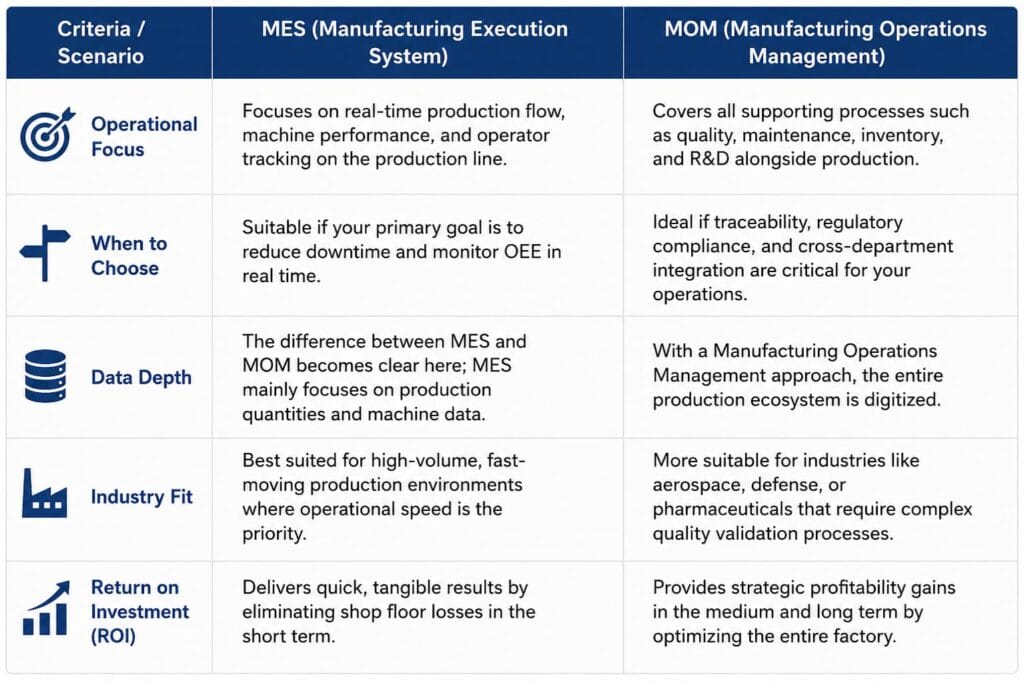
This manufacturing systems comparison serves as a guide to understanding where your organization stands in its digital transformation journey. Choosing the right system is not only about addressing current needs but also about supporting your future scalability goals. The right solution is the one that clearly reveals production bottlenecks and supports decision-making with data-driven insights.
If micro-level control and shop floor discipline are your priorities, investing in MES is a logical first step. However, if your goal is to transform your factory into a fully synchronized, intelligent organization where all departments operate in harmony, then adopting a MOM platform is the more strategic choice.
Start Transforming Your Manufacturing Operations
Turning production data into strategic value is no longer optional—it is essential. ProManage combines the capabilities of MES and MOM into a single AI-powered platform, helping your business evolve into a smart factory.
With IoT-enabled infrastructure, you can detect losses instantly and automate continuous improvement processes using Agentic AI. Define your digital transformation roadmap with ProManage.